


If you want to know how to get better at public speaking, you don’t need a speaker personality. You need a simple system: a clear message, a repeatable practice routine, and a few delivery rules that work under pressure. This guide shows how to get better at public speaking for meetings, presentations, and real speaking engagements, without sounding scripted or salesy.
How to get better at public speaking?
If you’ve searched how to get better at public speaking, you’ve seen the same advice on repeat: practice, make eye contact, breathe, and be confident. True, but incomplete. The reason most public speaking tips don’t stick is simple: they’re scattered. People collect tips like souvenirs, then freeze the moment a room stares back.
Treats how to get better at public speaking like a skill, more like learning to drive than finding your voice. You’ll learn how to get better at public speaking by fixing the few things that matter most: message, structure, practice, and delivery under stress.
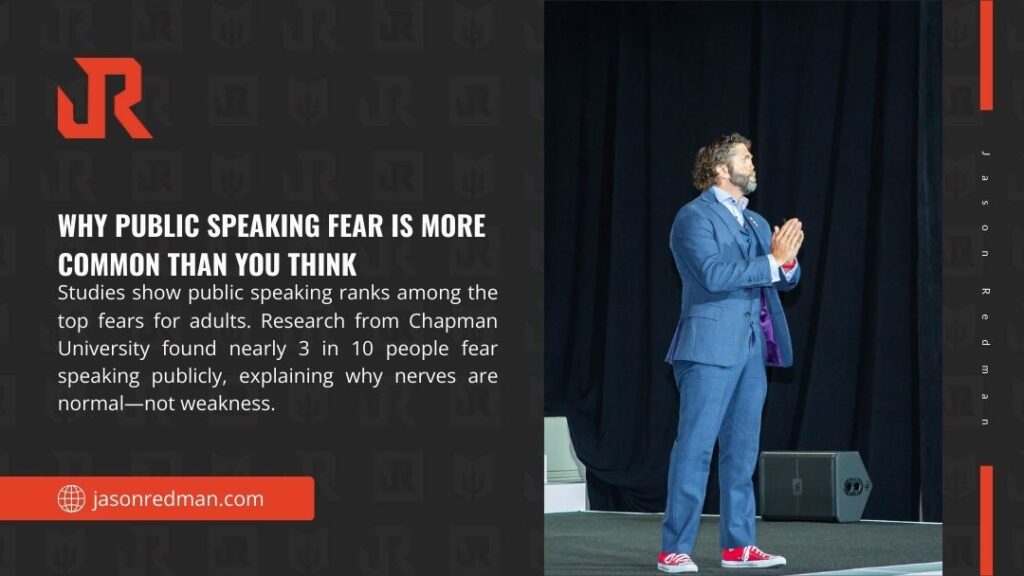
One more reality check: fear is common. Chapman University’s research has shown public speaking still sits on many Americans’ fear lists (their reporting calls out public speaking around 29% in one wave). That doesn’t mean you’re broken; it means you’re human.
And social anxiety itself affects a meaningful slice of adults; the National Institute of Mental Health estimates 7.1% of U.S. adults had social anxiety disorder in the past year. Not every nervous speaker has that diagnosis, but it explains why just relax is useless advice.
Why most public speaking tips fail in real life (and what works instead)
Most advice fails because it’s not tied to a repeatable process. If you want to know how to get better at public speaking to stop feeling like a mystery, you need to treat each talk as three jobs:
Job one is to decide what the audience should remember. Job two is to build a structure that carries that point. Job three is to practice in a way that makes delivery automatic enough to survive nerves. That’s it. Everything else, slides, stories, jokes, gestures, sits on top of those three.
A quick self-check: what’s actually holding you back?
When people say they want to know how to get better at public speaking, they usually mean one of these problems:
Some folks go blank because the speech lacks structure. Some ramble because they don’t know their point. Some feel shaky because they haven’t practiced in conditions that resemble the real moment. And some speak fine, but their presentation skills crumble with slides, timing, or Q&A.
This guide covers all of it, but you’ll progress faster if you’re honest about your bottleneck. The good news: once you fix the bottleneck, getting better at public speaking becomes a lot less dramatic.
Public speaking confidence: how to speak in public confidently without faking it
Confidence isn’t a vibe. Confidence is evidence. When your brain has proof you can do something, it stops screaming danger. If your core issue is fear, start with practical exposure and control tools. Don’t wait to feel ready. You get ready by doing the work.
If nerves spike before you speak, Jason Redman’s perspective on the fear of public speaking offers a clear mental framework for staying grounded when pressure builds. It fits naturally alongside this discussion, especially in moments when anxiety starts to take over.
How to overcome fear of public speaking with exposure that doesn’t feel like punishment
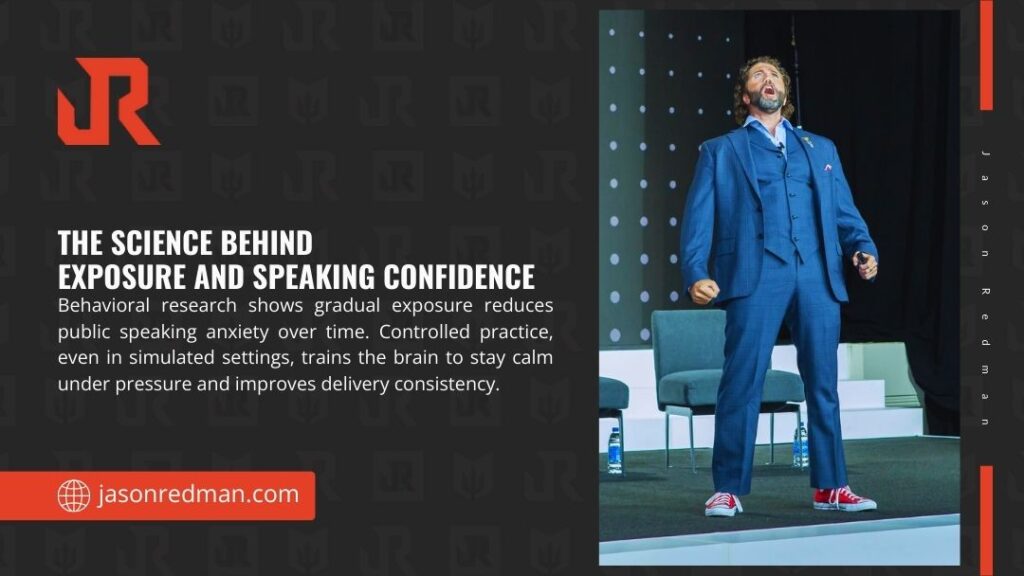
If you only practice in your head, the first real exposure happens in front of people, basically the worst possible time. Research reviews on exposure-based approaches, including newer tools like virtual reality (VR) exposure, show that exposure can reduce public speaking anxiety and can be comparable to traditional methods in some contexts. You don’t need VR. You need staged difficulty.
Start with a low-stakes audience: one person you trust. Then a small group. Then a room that matters. Each step is practice for the next. This is how to get better at public speaking, which becomes predictable instead of terrifying.
Breathing, pace, and eye contact that make you look calm
The fastest way to look confident is to sound controlled. Two levers do most of the work: pace and pausing. Most nervous speakers speed up, then run out of breath, then lose clarity. Slow down. Pause at the ends of sentences like you own the floor. Eye contact helps because it turns a crowd into a person, which reduces that weird feeling of speaking into a void. Coursera points out that eye contact can make you feel more at ease because you get real-time feedback from faces.
If you want a pressure-tested alternative to the X-style approach to composure, Jason Redman’s perspective offers a grounded way to build steadiness through preparation and self-leadership. His take on How to be confident under pressure aligns closely with how disciplined habits translate into calm execution when the stakes are high.
How to speak clearly and drop filler words without sounding robotic
People try to remove ums by clamping down, then they sound stiff. A better method is to replace filler words with a silent pause. Silence feels long to you and normal to everyone else.
Clarity also improves when you shorten sentences. That’s not dumbing it down. That’s respect. If you want how to get better at public speaking to show up in your voice, don’t chase fancy language. Chase clean language.
How to improve public speaking skills with a repeatable practice system
Practice is the boring answer that works. But most people practice incorrectly. They rehearse the best-case version: quiet room, no interruptions, perfect memory. Then they wonder why the real talk feels different.
If your question is how to get better at public speaking, the answer is: practice like you’ll perform. Same constraints, same timing, same transitions, same slides if you use them.
For a focused perspective, work on How to Improve Public Speaking explores both the practical fundamentals and the mindset required to communicate with clarity, which aligns naturally with the system outlined below.
Speech practice that fits your schedule: 10 minutes, 30 minutes, 60 minutes
Time is the most common excuse. Fair. So use a plan that respects reality. A short practice is not a bad practice. It’s a focused one. When someone asks how to get better at public speaking fast, the quickest returns come from rehearsing openings, transitions, and the close, because those are the moments where anxiety spikes.
Practice plan by timeline and goal
| Time you have | What to practice | What it improves | What to avoid |
| 10 minutes | Opening + first transition + closing line | Calm start, clean finish, fewer rambles | Running the whole talk fast |
| 30 minutes | Full run once, then re-run the weakest section | Timing, flow, confidence | Constantly restarting from the top |
| 60 minutes | Full run + Q&A drill + recorded review | Delivery polish, audience control, and recovery skills | Memorizing every word |
When you repeat this plan, how to get better at public speaking stops being vague. You’ll know exactly what you did to improve.
Presentation practice: rehearsal methods that catch timing and weak transitions
Most bad talks are really a transition problem. The speaker knows the points but can’t move between them cleanly.
Here’s what works: speak your transitions out loud as full sentences, not mental notes. Now that we’ve covered X, here’s why Y matters. Those connective lines are the rails. They keep the audience from getting lost, and they keep you from panicking.
Feedback that improves you without crushing your confidence
Feedback becomes helpful when it’s specific. You were great, does nothing. You lost us at minute six because the point wasn’t clear and is actionable. If you want structured feedback viewed through a performance lens, coaching plays a practical role. Jason Redman’s approach emphasizes performance standards and personal accountability over motivational language, which can help teams and leaders maintain consistency over time.
How to write a good speech: a structure that makes a public speech easy to follow
Writing matters because a well-structured talk is easier to deliver. When people ask how to get better at public speaking, they often focus on delivery and ignore writing. That’s backward. If the speech is a mess, the delivery has no chance. A clean public speech has one controlling idea. Everything else supports it.
Ways to start a speech that earn attention in the first 20 seconds
Strong openings do one of three things: create tension, promise value, or reveal stakes. Harvard’s speaking guide emphasizes grabbing attention early and building a framework before you speak. If you want a reliable opener formula: state the situation, state the cost, state the point. Not dramatic, just clear.
The one idea + three supports pattern for better speech skills
This pattern is boring in the best way. It works almost every time.
- One idea: what you want them to believe or do.
- Three supports: proof, example, and practical step.
When you stick to this, how to get better at public speaking becomes easier because your brain has fewer moving parts.
How to make a speech sound human: rhythm, pauses, and simple language
Human speech has shape. You speed up on easy lines and slow down on important lines. You pause before the key phrase. You repeat a short sentence for emphasis. A speech that sounds human usually wasn’t written like an essay. It was written to be heard.
Speech structure templates by purpose
| Purpose | Best structure | What the audience wants | Best closing move |
| Inform | Problem → explanation → takeaway | Clarity and relevance | “Here’s what to do next.” |
| Persuade | Claim → evidence → objection → decision | Proof and trust | Clear ask + reason |
| Inspire | Story → lesson → action | Meaning and momentum | Short pledge or commitment line |
| Train | Goal → demo → practice → checklist | Usable steps | Quick recap + next drill |
Use these templates, and you’ll notice how getting better at public speaking starts to feel mechanical, in a good way.
Presentation skills that make a good presentation without flashy slides
Slides don’t save a weak talk. They amplify it. Strong presentation skills are less about design and more about decision: what goes on the slide versus what stays in your mouth.
Presentation techniques for slides: what to show, what to say, what to cut
A slide should carry what the audience can’t easily hold in memory: numbers, a visual, a quote, or a simple framework. If the slide repeats what you’re saying word-for-word, people stop listening because they can read faster than you can talk.
When people ask how to get better at public speaking, slides are often the hidden culprit. Fix slides and your delivery improves overnight.
Visual aid for speech: when it helps and when it sabotages you
A visual helps when it clarifies. It sabotages when it distracts. If you use a chart, you must tell them what to look at. Otherwise, half the room stares at the axes while you talk about something else. That’s how you lose people.
Training presentations and meetings: the same rules, different tempo
A boardroom talk needs brevity. A training needs pacing and interaction. A keynote needs story and structure. But the core answer to how to get better at public speaking stays the same: one point, clear structure, practiced transitions, controlled delivery.
Speaking in public for work: how to present to executives, clients, and teams
Workplace speaking has a specific pain: you’re judged in real time by people who control budgets, promotions, and partnerships. That’s why just be yourself feels insulting. You’re not at open mic night.
Executive speech basics: clarity, brevity, decision focus
Executives want decisions. That means you must lead with the point, not the backstory. If you want to know how to get better at public speaking in professional rooms, learn to state your recommendation in the first minute, then support it.
How to introduce a speaker and handle the handoff like a pro
Introductions matter because they frame authority. If you introduce someone, name them clearly, give one credential that matters to the audience, and then state why this talk matters today. Keep it short. If you’re the speaker, step up, thank them once, and begin. Don’t wander. Wandering is how nerves win.
Speaking engagements: Q&A, tough rooms, time limits
Q&A scares people because it breaks the script. The fix is simple: prep the top ten questions. Write short answers. Practice calm. I don’t know, but here’s what I do know. If you want the mindset behind handling tough moments, Jason Redman’s Sign on the Door story offers a powerful reminder that adversity can be approached as a deliberate stance rather than a panic response.
How to become a public speaker (and get better fast)
A lot of people don’t just want to know how to become a public speaker and earn real speaking engagements. That path is less glamorous than social media makes it look. It’s built on reps, audience outcomes, and reliability.
Public speaking club vs coach vs course: what to choose and why
Toastmasters-style clubs build comfort through repetition. A coach builds speed through targeted correction. A course builds knowledge and structure. The right choice depends on your bottleneck.
If your bottleneck is confidence and consistency, consider a structured program. Jason Redman offers courses such as Overcome Mindset that focus on performance under pressure and habits that hold.
If your bottleneck is structure and leadership communication, his Pointman for Life training route sits closer to self-leadership, planning, and execution.
Public speaking classes near me: what to look for so you don’t waste money
A solid public speaking course or class gives you: frequent speaking reps, recorded playback, detailed feedback, and structured skill progression. If it’s mostly lectures, it’s entertainment, not training.
Training options compared
| Option | Best for | Trade-off | Who it fits |
| Public speaking club | Comfort, repetition, steady reps | Slower skill correction | Beginners who need low pressure |
| Public speaking course | Structure, frameworks, guided practice | Quality varies by instructor | People who want a system |
| 1:1 coaching | Fast skill gains, tailored feedback | Higher cost | Leaders with high-stakes talks |
| Self-practice + recordings | Cheap and flexible | Easy to skip | Disciplined learners |
If your real goal is speaking engagements, professional polish matters. That’s why many speakers layer options: club for reps, coaching for correction, and a course for frameworks. It’s also why how to get better at public speaking becomes easier once you pick one path and stick with it.
Public speaking tips for beginners that show up immediately
Beginner improvements are often physical, not intellectual. It helps you to get better at public speaking quickly, and fix what the audience can hear and see right away.
How to speak better with posture, pacing, and clean endings
Stand still when you hit key lines. Move only when you change sections. End sentences fully. Many speakers trail off because they’re already thinking of the next line. That habit makes you seem unsure even when your content is strong.
How to talk better in front of groups: audience interaction that isn’t awkward
You don’t need gimmicks. Ask one question, then pause long enough for people to think. A short pause feels brave. It also signals you’re in control.
What makes a good public speaker (and what’s just stage mythology)
Good speakers aren’t born; they’re built. They practice, they edit, and they learn recovery. They also understand the job: serve the audience, not the ego.
A stronger way to step up next time
If you’ve read this far, you’re not looking for cute tricks. You’re looking for a reliable answer to how to get better at public speaking that holds up in real rooms with real stakes.
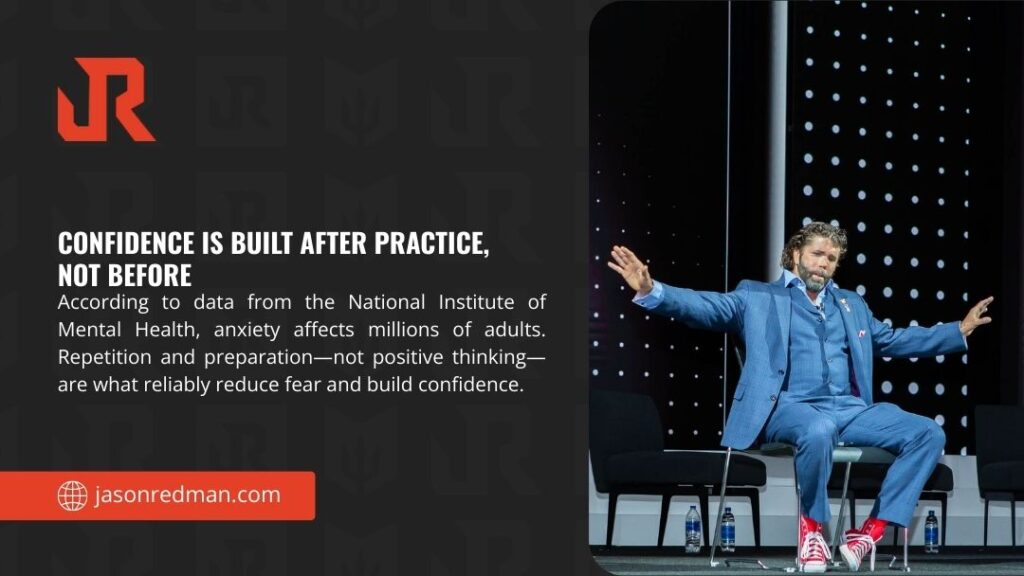
Here’s the thing: the fastest path is not more charisma. It’s clearer structure, better practice, and controlled delivery. When you repeat that cycle, you’ll notice something funny: confidence shows up after the work, not before it. And that’s why it matters.
If you want to keep building, do it in a sequence. Read a proven guide, then commit to a practice plan, then get feedback. You can even explore a structured speaker ecosystem. Jason Redman’s work spans mindset, performance, and leadership, and his broader platform ties together speaking, coaching, and training resources in one place.
And if you want a clean, practical next step today, pick one upcoming talk, meeting update, client pitch, or training session, and apply the system. Do that once, then do it again. That’s how to get better at public speaking stops being a search query and becomes a skill you can count on.