

Preparing for a presentation isn’t about rote memorization or faking it until you make it. It’s actually a process of intentional structure and strategic repetition. This guide breaks down the preparation process so your message lands with impact, even when the pressure is on.
How to prepare for public speaking?
The journey toward great public speaking starts with clarity, not confidence. It’s a common misconception that you need to feel brave before you step on stage; in reality, confidence is the byproduct of a solid plan.
Effective preparation means anchoring yourself in three things: your “why,” your specific audience, and the desired outcome. Without these pillars, even the most seasoned pros can lose their way.
Beyond the words themselves, you need to account for your environment. Factors like room acoustics, audience size, and strict time limits should dictate your delivery style. A quick 10-minute executive update requires a completely different vibe than a 60-minute keynote. When your prep accounts for the context, you feel in command rather than just surviving the moment.
The best speakers also know how to edit. They aggressively prune their content, cutting anything that doesn’t serve the core mission. This restraint ensures the audience isn’t overwhelmed by cognitive load and keeps the focus exactly where it belongs.
Why public speaking feels harder than it should
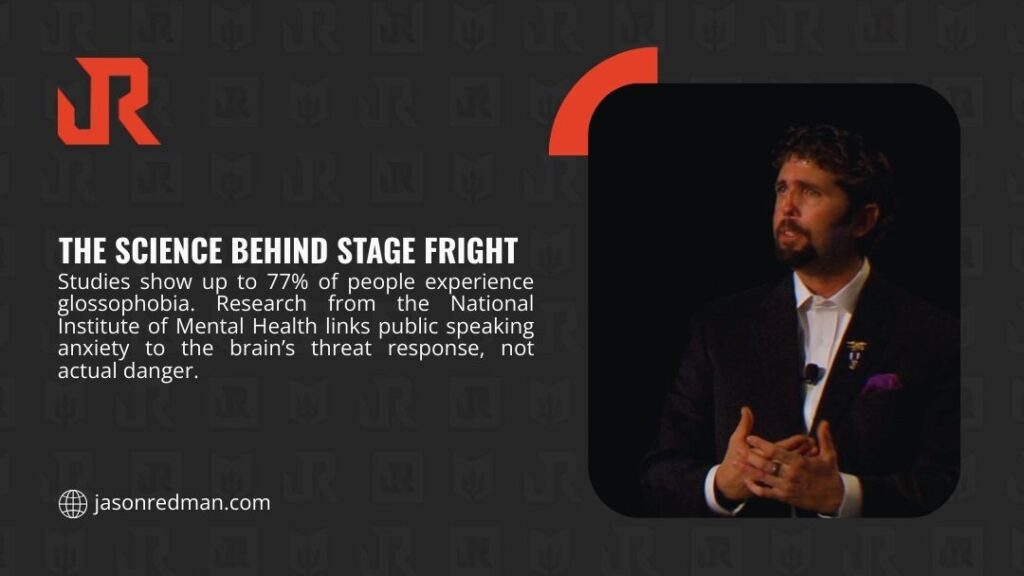
If your heart races before a speech, it’s because of a deep-seated social survival mechanism. Evolutionarily speaking, humans are wired to fear isolation or rejection by the tribe. Standing alone while a room full of people stares at you triggers a primal fight or flight response. Your body reacts to a perceived threat before your logic can catch up.
Another hurdle is the perfection trap. Many presenters aim for a flawless performance rather than a clear one. Perfection is a high-pressure, internal goal; clarity is a high-value, external service to your audience. When you shift your focus to being understood rather than being perfect, the anxiety often dissipates.
Finally, we have to stop obsessing over minor slips. Audiences are surprisingly forgiving and rarely notice the small stumbles that feel like earthquakes to the speaker. Recognizing this physiological reality helps reframe stage fright as just adrenaline, not a personal shortcoming.
What good speakers do before they ever write a speech
Experienced orators treat the actual writing as the final piece of the puzzle. They build the skeleton before they add the skin.
| Preparation Area | What Average Speakers Do | What Good Speakers Do |
| Audience focus | Assume general interest | Define specific audience pain points |
| Message clarity | Try to cover five ideas at once | Nail down one single takeaway |
| Outcome | Hope people “like it.” | Decide exactly what should change |
| Structure | Start writing from slide one | Map out the flow before touching a keyboard |
By establishing this framework first, the actual writing becomes surprisingly fast. You aren’t hunting for a direction because the map is already sitting right in front of you.
How to structure a speech so it makes sense to the listener
A solid structure is what allows an audience to actually relax. If listeners can’t tell where you’re going, they get mental fatigue and tune out. They are subconsciously looking for a roadmap.
| Speech Section | Purpose | Listener Benefit |
| Opening | Hook the room and show value | Immediate engagement |
| Main body | Prove the core thesis | Seamless understanding |
| Transition | Connect the dots | Mental breathing room |
| Close | Drive the point home | Long-term retention |
Knowing your waypoints also acts as a safety net. When you know exactly what the next island of your speech is, you won’t panic if you lose your place for a second.
How to start a speech without losing the room
The first 60 seconds are your most valuable real estate. Don’t waste them on long-winded thank-yous or about me slides that nobody asked for. Strong openings respect the audience’s time.
Your opening should answer the Why should I care? question immediately. You can do this with a provocative question, a surprising statistic, or a bold promise. You don’t need to be loud or theatrical to be confident; you just need to be relevant.
Writing words that sound natural when spoken
We don’t talk the way we write. If you use academic, written-word phrasing, you’ll end up sounding like a robot. Your sentences need to breathe, and your ideas need to land with a punch.
| Better to Use | Better to Avoid |
| Short, punchy sentences | Run-on, compound sentences |
| Conversational “street” talk | “Corporate-speak” or jargon |
| Verbal signposts | Abruptly jumping topics |
| Active voice | Passive, “roundabout” phrasing |
The ultimate litmus test? Read your draft out loud. If you find yourself running out of breath or tripping over a phrase, it needs to be rewritten. The ear is a much better editor than the eye when it comes to speechwriting.
Presentation skills that make ideas stick
Great delivery shouldn’t be a distraction; it should be an amplifier. Whether it’s your slides or your hand gestures, every movement should serve the message.
| Skill | Purpose | Audience Effect |
| Pacing & Pauses | Let the big ideas sink in | Higher retention |
| Minimalist Visuals | Support, don’t repeat the talk | Clarity of focus |
| Vocal Inflection | Signal what’s important | Sustained energy |
When done correctly, these skills feel invisible. The audience won’t leave thinking “they had great pacing”; they’ll leave thinking, “Wow, I really understood that concept.”
How to practice public speaking without wasting time
Don’t just read your notes over and over. That’s passive practice, and it doesn’t work. True rehearsal is active. Try recording yourself on your phone; it’s painful to watch, but it’s the fastest way to spot filler words like “um” or “ah.”
Target your weak spots specifically. If your intro is shaky, practice just the intro ten times. You’ll get much further with 20 minutes of focused work than two hours of mindlessly reciting your slides.
How to build confidence in public speaking over time
Confidence is essentially proof of work. Every time you speak and don’t die, your brain updates its software to realize it isn’t in danger. It’s a compounding loop: better structure leads to better delivery, which leads to better audience feedback, which finally builds real confidence.
How to speak in public confidently when nerves show up
Nerves aren’t a sign that you’re unprepared; they’re a sign that your body is “repping up” for a performance. Even the pros get them. The trick is to use physical tools like box breathing or intentional pauses to keep your heart rate under control. If you expect the nerves, they can’t surprise you. And if they can’t surprise you, they can’t control you.
Common public speaking mistakes that undermine credibility
Sometimes it’s the little things that trip us up. Awareness is 90% of the cure here.
| Mistake | Impact on Audience | Correction |
| The “Speed Demon” | The audience can’t keep up | Build in “breath” pauses |
| Filler Word Overload | Signals a lack of authority | Embrace the silence |
| Reading the Slides | Boredom and disconnect | Treat slides as “wallpaper.” |
How public speaking skills transfer to leadership and career growth
Communication is the primary force multiplier in a career. If you can speak clearly, you can lead clearly. It builds a level of executive presence that is hard to ignore in a corporate or high-stakes environment.
| Speaking Skill | Leadership Outcome |
| Clarity of Vision | Team alignment |
| Audience Empathy | Increased buy-in |
| Steady Presence | Trust under pressure |
When training, coaching, or guidance makes sense
We are often the worst judges of our own performance. We either over-analyze small flaws or are blind to major habits. This is where outside coaching becomes invaluable. A coach provides the objective external eye needed to break through a plateau.
How to prepare for public speaking when the stakes are high
In high-stakes moments, “Plan A” isn’t enough. You need redundancy. What happens if the projector breaks? What if the previous speaker goes 10 minutes over? Elite speakers engage in scenario planning so they can adapt on the fly without breaking a sweat.
Why preparation beats talent every time
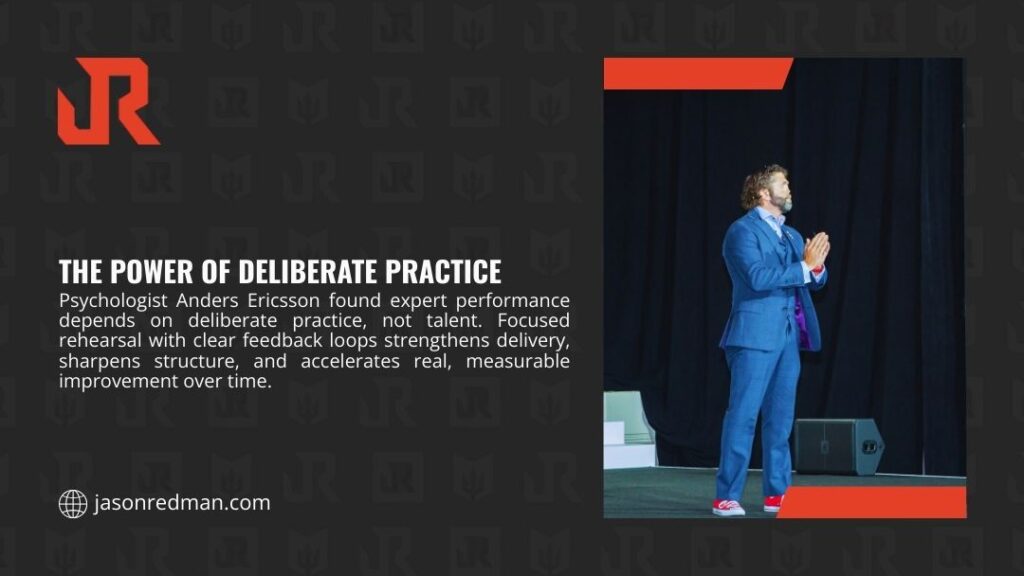
Natural charisma might get you through a wedding toast, but preparation is what sustains a career. The data on skill acquisition is clear: deliberate practice and structured preparation will always outperform raw talent in the long run. Preparation creates reliability, and reliability is the foundation of professional trust.
Where preparation turns into authority
True authority isn’t something you’re born with; it’s something you build through the quiet work of preparation. This discipline carries over into every facet of leadership and high-stakes performance.
If you’re ready to stop winging it and start leading from the front, it helps to learn from those who have mastered the craft under extreme conditions. Jason Redman’s journey as a leadership and elite performance speaker is a testament to the power of preparation and accountability. His methods aren’t just for the stage; they are for any environment where clarity and leadership are non-negotiable.
Explore his strategies for public speaking and professional growth. Start preparing like an elite performer, with intention, purpose, and a plan that never fails.